



 CUSTOMER PORTAL
Aravo vs ProcessUnity: Which TPRM Platform Is Right for Your Enterprise?
Aravo and ProcessUnity can both manage enterprise TPRM programs. So the decision is less about who has the longer feature list and more about how you want the program to run.
- ProcessUnity puts more emphasis on standardization, automation, and reusable vendor intelligence.
- Aravo gives enterprises more control over how workflows, assessments, scoring, approvals, risk domains, and governance are structured, and drives a 360-degree view of risk across the entire organization.
For a relatively standardized program, that difference may not matter much. But for organizations dealing with multiple regulators, business units, and risk models, it can shape almost everything about how the platform is implemented and used.
Here’s where each one fits best.
Aravo and ProcessUnity overview
Aravo and ProcessUnity are both full-lifecycle TPRM platforms. They cover much of the same core ground, but they are built around different ways of running third-party risk.
What is Aravo?

Aravo is an enterprise TPRM platform built for large, regulated organizations managing risk and compliance across the extended enterprise of vendors, suppliers, third and nth parties, driving a 360-degree view of risk.
It manages the full vendor lifecycle from intake and onboarding through inherent risk assessment, due diligence, approvals, continuous risk and performance monitoring, remediation, reassessment, reporting, and offboarding.
Aravo supports 50+ risk domains, including cybersecurity, privacy, financial risk, ESG, ABAC, business continuity, and supplier risk.
Additionally, with Aravo, teams create custom risk domains, scoring models, assessments, approvals, and dashboards around their own processes, allowing risk teams to create domains unique to their business, region, or industry.
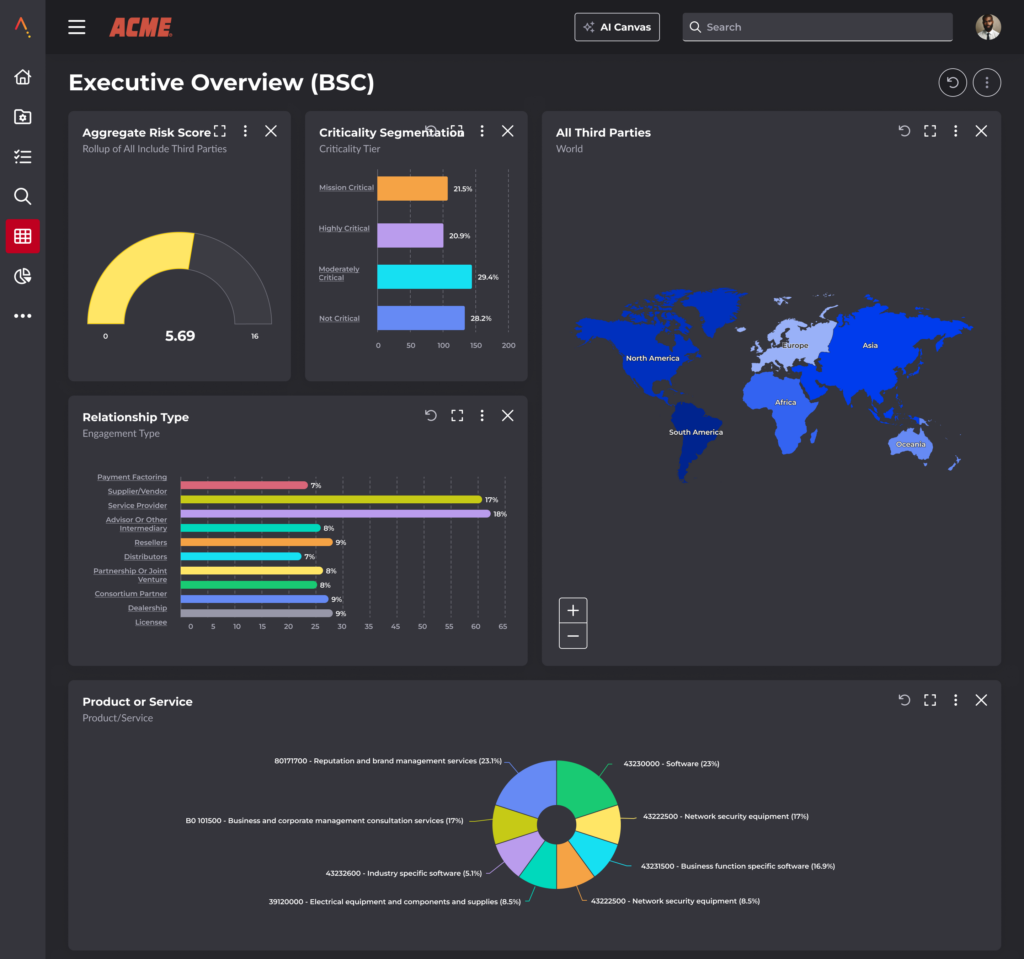
Aravo also brings procurement, risk, regulatory compliance, security, and other stakeholders into one governance process. Aravo also has a robust Integration Framework that supports integration with 45+ risk intelligence partners as well as existing applications like vendor and supplier management, ERP, and other customized solutions. Aravo unifies external risk intelligence and enterprise system data into the same TPRM environment.

What is ProcessUnity?
Similar to Aravo, ProcessUnity is a full-lifecycle TPRM platform for vendor onboarding, due diligence, assessments, monitoring, remediation, and ongoing oversight.
A major part of its value is helping teams avoid repeating work they may already have access to.
- The Global Risk Exchange provides reusable vendor profiles, assessments, and risk intelligence, while
- ProcessUnity Risk Index helps bring internal and external signals together so teams can prioritize where attention is needed.
ProcessUnity also supports configurable workflows, multiple risk domains, and AI-assisted review. It’s more of a fit for organizations that want a more standardized TPRM process and can reuse existing vendor intelligence instead of starting every assessment from scratch.
Aravo vs. ProcessUnity at a glance: how do they compare?
The head-to-head table below summarizes how Aravo and ProcessUnity compare across ten criteria that typically shape a TPRM platform decision.
| Evaluation criteria | Aravo | ProcessUnity | Better fit |
| Best for | Large, global, highly regulated enterprises that need their TPRM program to adapt as business structures, regulations, and operating models change—including through acquisitions and divestitures | Enterprises that want a more standardized TPRM approach with assessment automation and vendor intelligence | Depends on operating model: Aravo for companies that want to configure the solution to reflect their processes and can easily change as their processes evolve; ProcessUnity for third-party onboarding and turnkey assessments that are less easy to configure and change as their business, risk or compliance needs change |
| Workflow configurability | Deep configuration across workflows, scoring, assessments, approval paths, data structures, and risk domains, with the flexibility to evolve these elements as the business changes | Configurable workflows with more emphasis on packaged processes and standardized deployment, which may make significant post-implementation changes more involved | Aravo |
| Multi-domain risk | Supports 50+ risk domains, including customer-defined domains | Covers major TPRM risk domains and extends coverage through integrations and external data | Aravo, if your risk, regulatory, and business environment is dynamic |
| Enterprise scale | Built for large multinational programs with many third parties, business units, regions, integrations, and regulatory requirements | Enterprise-ready and capable of supporting large TPRM programs | Aravo for the most complex environments where managing risk is a strategic initiative for the business and must adapt as risk, regulation, and organizational changes is the norm |
| Auditability and regulatory complexity | Strong focus on traceable decisions, approvals, governance, controls, and regulatory scrutiny | Regulatory compliance controls and support for auditable TPRM programs | Aravo for highly regulated environments and companies that need strong audit support |
| Reusable vendor intelligence | Pulls external intelligence from 45+ providers into customer-specific risk models and workflows | Global Risk Exchange provides reusable vendor profiles, assessments, and risk data | ProcessUnity |
| Deployment approach | More upfront configuration, but greater flexibility to adapt as business structures, regulations, risk models, and operating requirements change | A more packaged model can reduce initial design and configuration, but may require more effort to reconfigure after implementation when the business or regulatory environment changes | ProcessUnity for faster standardization; Aravo for long-term adaptability through acquisitions, divestitures, regulatory change, and operating-model evolution |
| AI customization and governance | AI Canvas, AI Studio, workflow and interactive agents, multiple LLM options, MCP, citations, confidence scores, and human oversight | Purpose-built TPRM agents plus Agent Architect for configuring agents | Aravo for flexibility and governance |
| Lifecycle coverage | Intake, onboarding, assessments, monitoring, remediation, reassessment, reporting, and offboarding | Full lifecycle from onboarding and due diligence through monitoring, remediation, and offboarding | Aravo for deeper, more configurable lifecycle orchestration across complex enterprise TPRM programs |
| Risk intelligence model | Combines customer data and external intelligence inside configurable enterprise workflows | Strong shared intelligence model through Global Risk Exchange and Risk Index | Depends on whether you want orchestration or shared intelligence |
| Orchestration flexibility | Deeply configurable across workflows, risk domains, business rules, approvals, data, and operating models—including changes driven by acquisitions, divestitures, and new regulations | More standardized orchestration built around packaged processes and reusable intelligence, with less flexibility for substantial operating-model changes after configuration | Aravo |
Note: Both platforms cover the third-party lifecycle, but lifecycle coverage and orchestration depth are not the same thing. The bigger difference is how much control an enterprise has to adapt that lifecycle to its own operating model.
| Summary Aravo is better suited to highly customized, dynamic TPRM programs, while ProcessUnity works for teams that want a more packaged model with reusable vendor intelligence and assessment efficiency. |
What are the key differences between Aravo and ProcessUnity?
Enterprise configurability: Deep customization vs. a more packaged TPRM model
Here, we’re looking at how much each platform expects the organization to shape the system around its own TPRM program.
Aravo
Aravo gives enterprises more control over how the TPRM program is designed. Teams can configure risk models, workflows, scoring, approvals, assessments, business rules, data structures, and risk domains across the full lifecycle.
That flexibility is important when different regions, business units, regulators, or functions follow different processes. Aravo lets you adapt the platform around those requirements instead of forcing one standard model. Additionally, Aravo can evolve as your business, risk landscape, and regulatory compliance needs change. Other solutions are appropriate if you expect the rate of change in your business, risk, or compliance landscape to be static.
ProcessUnity
ProcessUnity also offers configurable workflows, but it leans more toward standardized processes, automated workflows, and reusable vendor intelligence.
That can reduce setup and manual work for teams that want a more consistent TPRM model across the organization.
| Best fit: We recommend Aravo for enterprises that need deep configuration across the full TPRM lifecycle, and that can adapt as the business, risk landscape, and regulatory compliance evolve. You can consider ProcessUnity if you want a more standardized model with fewer configuration options and expect your requirements to remain static, with fewer changes in the future. |
Enterprise scale and global complexity
Two vendors may both serve large enterprises, but the complexity of those enterprises can look very different.
A relatively standardized third-party program has different needs from a $20B-$50B multinational operating across dozens of jurisdictions, business units, regulatory regimes, risk domains, and languages.
Aravo
Aravo is designed for large TPRM programs with complex structures that require a 360-degree view of risk across multiple domains.
It can support tens of thousands of third parties across multiple countries, business units, risk domains, approval paths, integrations, and regulatory requirements.
Aravo also supports 10M+ workflows annually and 40+ languages, making it well-suited to multinational programs that need local flexibility within one global TPRM framework.
ProcessUnity
ProcessUnity also supports large, mature enterprise programs and can operate at significant scale. But it’s best suited to organizations that don’t need the same level of regional variation, workflow complexity, or customization.
| Best fit: Aravo is built for enterprises whose TPRM programs need to scale across risk domains, business units, workflows, third-party populations, and regulatory requirements, while adapting as business needs, risk conditions, and operating models change. |
Multi-domain risk management: 50+ risk domains vs. a more focused model
Aravo
Aravo gives teams coverage across 50+ risk domains, including cybersecurity, privacy, financial viability, ABAC, ESG, DORA, business continuity, responsible sourcing, and reputational risk.
You can also create custom domains, allowing different types of risks that are connected to the same third-party record and lifecycle.
ProcessUnity
ProcessUnity covers the major third-party risk areas and extends that coverage through integrations and external risk intelligence.
Its model is more focused on standardizing common TPRM processes and reusing vendor intelligence across assessments.
| Best fit: Choose Aravo for broad, complex, multi-domain TPRM across one unified operating model. |
Risk intelligence: Enterprise orchestration vs. Global Risk Exchange
Aravo
Aravo connects data from 45+ external providers and enterprise systems, then uses those signals across scoring, monitoring, workflows, remediation, and decision-making.
This gives you more control over how intelligence feeds into different risk domains and processes.
ProcessUnity
ProcessUnity stands out with its Global Risk Exchange, which gives teams access to existing vendor profiles, assessments, and risk intelligence.
There’s also the ProcessUnity Risk Index that turns that data into usable vendor risk signals and reduces the need to repeat the same assessment work.
| Best fit: Opt for ProcessUnity when reusable vendor intelligence and pre-assessed data are the priority. Aravo is a better fit when you need to combine multiple intelligence sources inside a more customized TPRM program. |
Auditability and regulated industries
Both platforms support regulated enterprises and auditable TPRM programs.
But Aravo’s advantage is the ability to configure different controls, approvals, assessments, and decision paths for different regulatory environments without splitting the program across separate systems.
Aravo
Aravo is consistently cited as having strong auditability and control and is especially great for highly regulated industries such as financial services, life sciences, manufacturing, high tech, and consumer goods.
Teams can tailor workflows around specific regulatory requirements while keeping a complete record of the evidence reviewed, controls applied, approvals granted, exceptions made, and remediation completed.
Its regulatory use cases include DORA, FCA, and OCC guidance, along with FDA, EMA, GxP, HIPAA/HITECH, and FCPA requirements.
ProcessUnity
ProcessUnity covers frameworks such as DORA and APRA CPS 230, with features for evidence collection, reporting, vendor risk ranking, fourth-party mapping, and DORA Register of Information requirements.
| Best fit: Aravo for highly regulated enterprises that need to tailor controls, workflows, and decision processes across multiple regulatory environments and have stringent audit requirements. |
AI capabilities: Configurable enterprise AI vs. packaged TPRM agents
Aravo
Aravo brings native AI into enterprise TPRM through AI Studio.
Teams can create, tailor, and monitor AI agents around their own data, workflows, risk models, and business needs.
The platform supports multiple risk domains, document formats, languages, and LLMs. Secure MCP support and built-in safeguards help control how AI accesses and uses sensitive information.
Source citations, confidence indicators, and explanations make AI-supported decisions easier to review. Approvals, overrides, and full audit trails keep people in control as AI use expands.
ProcessUnity
ProcessUnity focuses more on purpose-built TPRM agents for tasks such as assessments, evidence review, monitoring, and remediation. Agent Architect also lets teams configure agents for their own workflows.
Those agents connect closely with the Global Risk Exchange and ProcessUnity’s vendor intelligence, making them useful for automating common TPRM tasks.
| Best fit: Aravo is great for AI flexibility, governance, model choice, and custom agents and workflows. For packaged TPRM agents tied closely to existing vendor intelligence, ProcessUnity is a good option. |
Implementation: Enterprise tailoring vs. faster standardization
Aravo
Aravo is highly configurable because it is designed to reflect organization-specific processes.
The benefit is greater flexibility over time as regulations, risk domains, business structures, approval paths, and operating models change.
Aravo’s depth reflects years of working with organizations that manage complex, evolving third-party risk programs across multiple functions, risk domains, geographies, and regulatory environments. For companies with smaller third-party portfolios, limited risk and compliance requirements, and relatively static programs, that level of scale and flexibility may not be necessary.
ProcessUnity
ProcessUnity’s more packaged approach may reduce design decisions for organizations adopting a standardized operating model. Actual deployment time for either platform depends on program scope, integrations, data requirements, and the complexity of the initial use case.
That makes it suitable for teams that want assessments, monitoring, and common TPRM activities running with fewer configuration decisions upfront and when teams do not anticipate changes to configuration in the future.
| Best fit: ProcessUnity for a more packaged deployment with fewer configuration decisions. Aravo for when you need the platform to support an enterprise-specific TPRM model that needs to evolve and adapt to your business. |
Analyst recognition and user reviews
Aravo
Aravo was named a Leader in the 2026 Gartner Magic Quadrant™ for Third-Party Risk Management Tools for Assurance Leaders.
Aravo was also listed in the Gartner Market Overview for Third-Party Risk Management Orchestration Platforms
The evaluation covers areas such as risk identification, analysis, escalation, continuous monitoring, and third- and fourth-party risk mapping.
Aravo was also named a Category Leader in the Chartis RiskTech Quadrant for Third-Party Risk Management Solutions for the sixth consecutive year.
In addition, customer feedback supports Aravo’s strength in configurability and complex enterprise workflows
- “Aravo brands themselves as a technology first company, however I have been most impressed by the level of detail they go to in their service. They are extremely well thought out and prepared. In addition they are invested in making you an expert in your own tool rather than having to keep paying for services. I see Aravo as a company that is truly invested in partnership with its customers.” (Read full review)
- “Aravo’s offering has been exceptional – from initial conversations through to implementation and post-implementation support.” (Read full review)
- “Great support throughout the implementation, from account management, design team and customer success. The Aravo team provided good insights on best practices and suggestions of design based on our level of maturity in TPRM.” (Read full review)
ProcessUnity
ProcessUnity was named a Leader in The Forrester Wave: Third-Party Risk Management Platforms, Q1 2026.
The evaluation highlighted areas such as dynamic questionnaire scoping, preconfigured AI workflows, and risk visualization.
Some of the reviews from customers include:
- “I find ProcessUnity TPRM Platform to be a highly configurable SaaS tool with an intuitive UI that allows a savvy business user to administer the tool without IT intervention.” (Read full review)
- “I use Process Unity in a daily basis hence its like a gold mine for me. Updating or replacing documents is straightforward, and a simple login is all you need to retrieve any file.” (Read full review)
Although some users also express poor documentation. For example, this user said:
- “In the absence of documentation explaining the rationale behind software customizations, a new administrator will lack the context needed to understand existing configurations.” (Read full review)
Aravo and ProcessUnity: Which platform matches your enterprise strategy?
Both Aravo and ProcessUnity are strong full-lifecycle TPRM platforms. But deciding which one to pick depends on how your program operates and how much complexity the platform needs to support.
- Choose ProcessUnity if you want a more standardized TPRM model built around automation and reusable vendor intelligence. Its Global Risk Exchange and ProcessUnity Risk Index can reduce repetitive assessment work and help teams scale due diligence without adding as much manual effort.
- Choose Aravo if you run a large, regulated, and more complex TPRM program. It supports 50+ risk domains, customer-defined processes, 10M+ workflows annually, and 40+ languages.
Aravo’s flexibility becomes more valuable as the program grows. More third parties usually bring more stakeholders, jurisdictions, approval paths, integrations, risk domains, and regulatory requirements.
The differentiator is not simply how much complexity exists today, but how easily the platform can accommodate tomorrow’s regulatory, organizational, and risk-management changes.
Aravo lets you maintain the governance model of your choice while adapting workflows and controls for different parts of the business.
A globally recognized financial services company highlighted that balance when it selected Aravo for its global third-party risk and performance program:
| “We selected Aravo Solutions for their proven track record in supporting global, enterprise clients who have complex vendor risk management programs. With Aravo, our supplier risk management program and processes will be standardized across the firm and the technology will enable consistent governance and oversight of supplier risk and performance across the enterprise.” — Head of Supplier Risk & Relationship Management |
Explore Aravo for your TPRM program
Aravo is worth considering if you manage a large third-party ecosystem across multiple risk domains, regions, and regulatory requirements.
Let’s talk about how the Intelligence First™ Platform can support your operating model →
FAQs
How much do Aravo and ProcessUnity cost?
Neither Aravo nor ProcessUnity publishes standard enterprise pricing.
Both use custom quotes based on factors such as program scope, number of third parties, configuration, integrations, external risk-data services, and support.
When comparing costs, look beyond the subscription. Implementation effort, ongoing configuration, and the amount of external data or services your program needs can affect total cost. Also, look for service offerings that will drive program success.
Which platform is better for risk assessment and due diligence?
It depends on what you want.
- ProcessUnity has an advantage when the priority is reducing repetitive assessment work through its Global Risk Exchange, reusable vendor information, and risk intelligence.
- Aravo is better when risk assessment, risk scoring, approvals, and due diligence need to vary across business units, geographies, risk domains, or regulatory frameworks. Its configurability also makes it better suited to organizations with more specialized processes.
Which platform is better for supplier risk and IT vendor risk management?
Aravo fits best for organizations that need to manage risk and compliance across a broad extended enterprise of vendors, suppliers, third parties, and nth parties. It is especially well-suited for organizations that need to manage third-party risk wherever it arises across the business. Depending on the company, that may include supply chain, procurement, compliance, legal, IT, operations, or other functions, all working toward a shared goal of protecting what matters most to the business.
Aravo supports more than 50 risk domains today, helping organizations drive sound business operations, secure and stable IT operations, regulatory compliance, ethical business practices, sustainable business practices, and supply chain resilience. As regulations evolve and new risk domains emerge, Aravo helps teams expand coverage without creating new silos, preserving connected data, shared governance, and a 360-degree view of the risks most important to the business.
Another option is ProcessUnity. It offers standardized assessments, cybersecurity intelligence, and vendor monitoring.
What are the best alternatives to Aravo and ProcessUnity?
The closest full-lifecycle alternatives include OneTrust, Diligent, Optro, and Certa.
Broader GRC platforms such as MetricStream and Archer also support third-party risk, but they are generally designed around internal risk, controls, audit, and compliance management.
While they can extend into third-party risk, organizations often struggle to make one platform serve both internal GRC needs and the external orchestration required to manage suppliers, vendors, third parties, and nth parties.
External third-party management typically requires more specialized workflows, relationship-level visibility, cross-functional collaboration, third-party data, and lifecycle governance than traditional GRC platforms were built to provide.
What type of platform is best if third-party cybersecurity risk is the main priority?
If your main concern is cybersecurity visibility, a cyber-focused platform such as BitSight, UpGuard, or SecurityScorecard may be a better fit than a full-lifecycle TPRM platform.
These tools focus on areas such as security ratings, external attack-surface monitoring, cyber risk signals, and ongoing vendor monitoring.
For broader programs, they can also feed that intelligence into Aravo or ProcessUnity alongside financial, compliance, privacy, and operational risk.
Aravo Content Team
Share with Your Friends:
