


 CUSTOMER PORTAL
Best Third-Party Risk Management Solutions for Enterprises: TPRM Platforms, GRC Tools, and Risk Intelligence Providers

TL;DR
|
Managing third-party risk gets harder long before you run out of vendors. The real challenge is knowing who you rely on, what risk they introduce, and what needs to happen when that risk changes.
For enterprise teams, that takes more than questionnaires or annual reviews. You need a clear view across suppliers, vendors, partners, contractors, and other third parties, with the workflows to assess, monitor, and act on risk throughout the relationship.
This guide compares 19 solutions that often appear in enterprise TPRM shortlists, including full-lifecycle TPRM platforms, GRC platforms with TPRM capabilities, cyber-risk intelligence providers, and compliance/vendor security review tools.
What Is Enterprise Third-Party Risk Management Software?
Enterprise Third-Party Risk Management (TPRM) software is the orchestration platform organizations use to identify, assess, monitor, and manage risk across the external companies they depend on.
That includes suppliers, vendors, SaaS providers, contractors, partners, and other third parties.
It gives teams one place to understand who each third party is, what they do, how critical they are, what data or systems they can access, and what risks they introduce.
From there, the platform can trigger the right due diligence, pull in outside risk data, route approvals, assign remediation work, and keep monitoring the relationship after onboarding.
| For example, if a bank wants to onboard a cloud provider that handles customer data, the platform can; flag the relationship as higher risk, require security and privacy reviews, bring in external intelligence, and stop approval until any serious issues are addressed. It then continues monitoring that provider throughout the relationship. |
In simple terms, it is the operating system for third-party risk, i.e., one place to see the risk, decide what needs to happen, and track that decision through to resolution.
Third-Party Risk Management Tools vs GRC Platforms vs Risk-Intelligence Point Solutions
These tools often work together, but they do different jobs.
- GRC (governance, risk, and compliance) platforms manage risk and compliance across the whole organization. They usually cover policies, controls, audits, regulatory requirements, and internal risk. Some include third-party risk modules, but TPRM is only one part of the platform.
- Risk-intelligence point solutions focus on one type of risk, such as cyber, financial health, sanctions, or ESG issues. They help you spot changes or warning signs, but they usually do not manage the full third-party relationship or the work needed to resolve an issue.
- Enterprise TPRM platforms manage the full third-party risk process. They keep the third-party record, run assessments and due diligence, bring in outside risk data, route approvals, track remediation, and continue monitoring the relationship over time.
| TPRM platform | GRC platform | Risk-intelligence tool | |
| Main job | Manage third-party risk | Manage organization-wide risk and compliance | Monitor a specific risk area |
| Focus | Vendors, suppliers, partners, contractors | Policies, controls, audits, internal risk | Cyber, financial, sanctions, ESG, etc. |
| Third-party lifecycle | Yes | Sometimes | No |
| Assessments and due diligence | Core capability | Often available | Limited |
| External risk data | Pulls in multiple sources | May integrate it | Usually provides the data |
| Remediation workflows | Core capability | General workflow support | Limited |
| Best for | Complex third-party risk programs | Broad GRC programs | Deep insight into one risk type |
What Makes a Platform “Full-Lifecycle” TPRM?
A full-lifecycle TPRM platform should support the entire relationship with a third party.
That involves helping you bring the vendor in, manage the risk while you work with them, prove how decisions were made, and end the relationship cleanly when the time comes.
Bringing the third party in
- Intake and onboarding: Capture who the third party is, what they provide, who owns the relationship, where they operate, and what systems or data they can access.
- Inherent risk assessment: Determine the level of risk the relationship poses before considering any controls or safeguards.
- Due diligence: Collect the appropriate questionnaires, documents, certifications, approvals, and supporting evidence before the relationship proceeds.
- Multi-domain assessment: Assess the risks relevant to that relationship, including common risk domains like cybersecurity, privacy, financial, compliance, ESG, and operational risk, along with 50+ unique and configurable risk domains like responsible AI, pharmacovigilance, and animal welfare.
Managing the relationship and its risk
- Workflow orchestration: Route assessments, approvals, escalations, and follow-up work to the right teams based on risk and business rules.
- Continuous monitoring: Track changes in a third party’s risk profile after onboarding using internal and external risk signals.
- Remediation: Turn findings into assigned actions, track corrective work, and escalate unresolved issues.
- Reassessment: Review third parties again when risk changes, contracts renew, or scheduled reviews come due.
- Configurability: Adapt scoring, workflows, assessments, and approval rules to the organization’s own risk model.
- Enterprise scale: Support large third-party populations across business units, countries, regulations, and third- and Nth-party relationships.
Proving what was assessed and decided
- Reporting: Give risk teams and leadership a clear view of high-risk third parties, open issues, assessment status, and changes in exposure.
- Auditability: Maintain evidence, approvals, risk scores, exceptions, remediation history, and decision trail behind each relationship.
Ending the relationship properly
- Offboarding: Manage the final steps when a third party leaves, including closing open issues, removing access, confirming data handling, and keeping the final record for audit purposes.
Best Full-Lifecycle TPRM Orchestration Platforms
1. Aravo: Best for complex, enterprise-wide third-party risk management (TPRM)
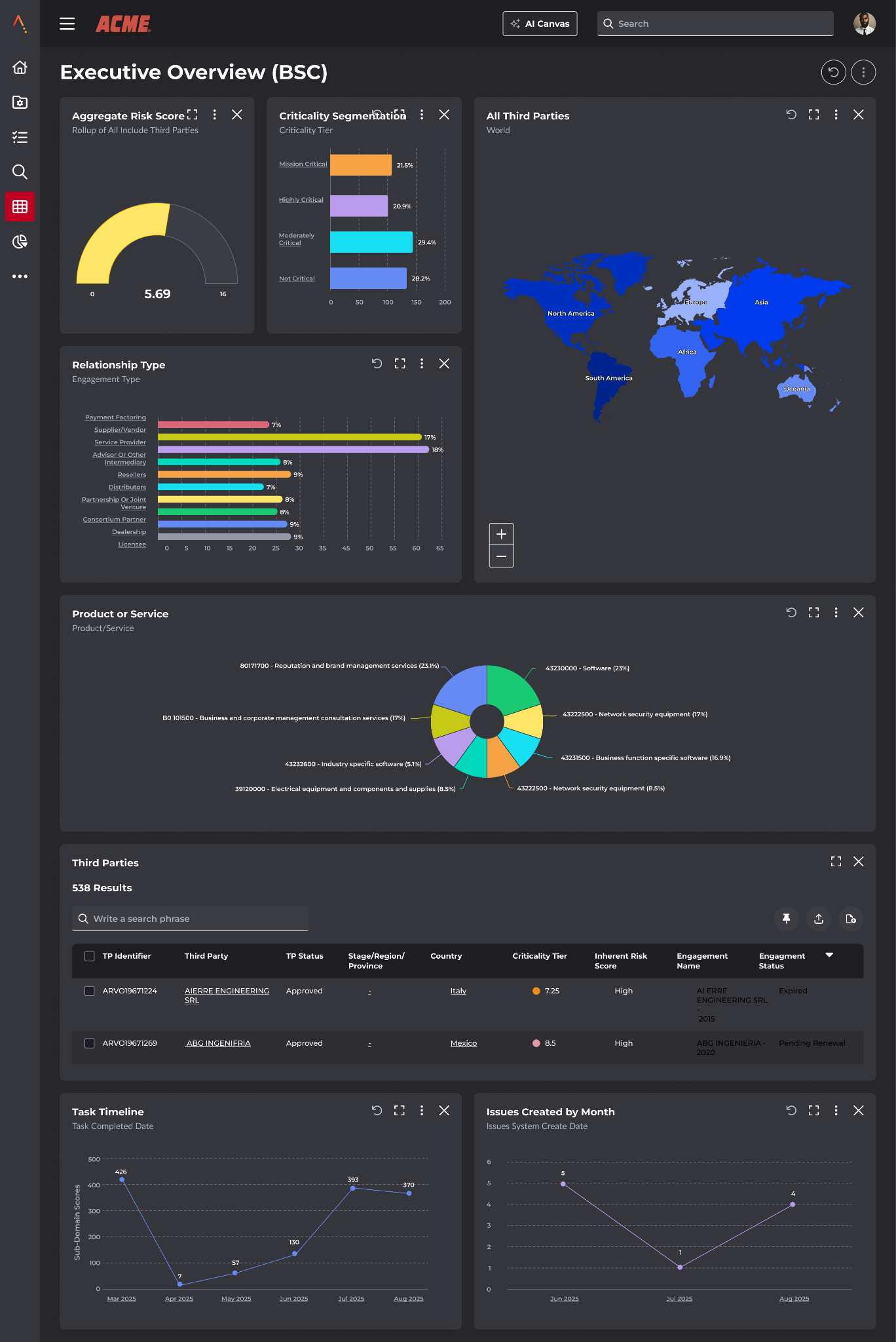
Aravo is a purpose-built enterprise TPRM platform for managing risk across the full third-party lifecycle. The Intelligence First™ Platform gives you one place to bring together third-party data, assessments, risk intelligence, workflows, monitoring, remediation, and reporting.
You can use Aravo to manage risk across cybersecurity, privacy, financial viability, ABAC, ESG, business continuity, and responsible AI, and create custom domains unique to your business, industry, or geographic location. It also helps you maintain visibility into fourth- and Nth-party relationships.
Plus, Aravo has proven scale, managing risk across more than 9 million third parties for Global 2000 companies in over 195 countries.
How Aravo works:

Aravo creates a central record for each third-party relationship. Then, it uses that context to guide assessments, due diligence, approvals, monitoring, and remediation.
External risk data feeds into the same record, while workflows route actions to the right teams and maintain an audit trail from onboarding through offboarding.
Key features
- Aravo AI: Includes AI Canvas, AI Orchestration, and AI Studio for querying risk data, automating workflow tasks, and managing AI agents across the platform.
- Evaluate Engine: Allows teams to build weighted risk-scoring models based on their own criteria, scoring ranges (up to 5,000 points), risk appetite, and risk domains.
- Lifecycle Management and Due Diligence: Manages third parties from onboarding through assessments, monitoring, remediation, renewal, and offboarding. Due diligence can also be adjusted by factors such as criticality, data access, and location.
- Custom Workflows: Uses the Events Engine, Workflow Engine, Visual Process Builder, and Process Monitoring to configure assessments, approvals, escalations, and corrective actions.
- Aravo Integration Framework and Connectors: Connects Aravo with 45+ risk intelligence providers and systems such as ERP, P2P, AP, GRC, and ERM platforms.
- Aravo Experience Framework: Combines modern interfaces, personalization, contextual information, and embedded Aravo AI to simplify how users work across TPRM processes.
Why Enterprises Choose Aravo for TPRM
- Built for complex enterprise TPRM programs: Aravo is designed for Global 2000 organizations managing thousands or tens of thousands of third parties across regions, business units, and risk domains.
- Highly configurable across the full lifecycle: Teams can shape assessments, scoring, workflows, approvals, and remediation to align with their TPRM program instead of adapting to a rigid model.
- Broader than cyber risk: Aravo can manage cybersecurity alongside privacy, financial, ABAC, ESG, business continuity, regulatory, operational, and other risk domains.
- Strong fit for regulated industries: Its enterprise focus is especially relevant for financial services, pharmaceuticals, technology, consumer goods, and other complex global businesses.
- Built for defensible decisions: Aravo keeps assessments, approvals, issues, remediation, and audit trails in one place, making it easier to support audits and regulatory reviews
- Turns risk intelligence into action: Aravo can ingest data from 45+ external risk providers and use those signals to trigger assessments, escalations, and remediation rather than stopping at a risk score.
- Combines the platform with TPRM expertise: Aravo also provides implementation support, value engineering, and its Strategic Alignment Framework® to help teams define program goals, responsibilities, maturity, roadmaps, and success metrics.
What Real Customers Are Saying about Aravo
| “The Aravo solution meets our complex, global needs for screening third parties for primary risk areas; collecting and validating supplier information required to support our procure-to-pay transactional processes; and integrating that information with our SAP ERP system.” Financial Services & Solutions Associate Director, Manufacturing Industry |
| “Through continuous improvement of our TPRM program, we’ve seen a 52% improvement in the turnaround times of our most in-depth Third-Party onboarding processes. Aravo’s technology has been crucial in enabling this optimization, enhancing our efficiency as a team.” SVP of Third Party and Model Risk Governance, Finance Industry |
| “One of our regulators recently informed us that we have the most mature TPRM program in South Africa, largely due to our partnership with Aravo.” Senior Third-Party Risk Manager, Global Financial Institution |
When is Aravo the Right Fit for Your Team
Aravo is a strong fit for large ecosystems managing a large ecosystem of suppliers, vendors, third- and nth parties multiple risk domains, and complex regulatory requirements.
It also suits organizations that need a central TPRM software and support to build or mature the program. However, smaller teams with a limited vendor list may find it more than they need.
Pricing
Plans are quote-based and depend on factors such as third-party volume, users, risk domains, and services.
2. OneTrust: Best for TPRM connected to privacy and data governance
OneTrust features a third-party management suite (formerly Vendorpedia) for managing vendors and other external relationships from onboarding through ongoing monitoring and offboarding.
Teams can build a centralized third-party inventory, tier vendors by risk, run assessments, collect due diligence information, and maintain an audit trail.
Key features
- Third-party risk exchange: Adds external risk intelligence directly to vendor records. It can combine OneTrust data with providers such as SecurityScorecard, RiskRecon, SupplyWisdom, and ISS Corporate Solutions, giving teams ongoing cyber, financial, operational, compliance, and ESG signals.
- Contextual risk tiering and assessments: OneTrust can use inherent and domain-specific risk information to decide how deeply a third party needs to be assessed. Questionnaires can also change based on earlier responses.
- Critical event workflows: Changes in a vendor’s risk posture can automatically trigger actions such as reassessments, notifications, mitigation workflows, or additional review.
- AI-powered data collection: AI can ingest external evidence and help generate questionnaire responses, reducing the amount of information teams need to collect manually during assessments.
- Risk mitigation and control frameworks: Teams can use more than 50 built-in control frameworks, import their own, assign risks to owners, and launch remediation workflows when assessment findings require action.
Advantages
- “Onetrust provides different modules like Cookie Banner (compliance with global laws), consent management, running data assessments, data mapping & data governance.” (Read full review)
- “Good Thing about OneTrust is it covers most of the aspects like project management, Risk register, policy implementation, Privacy management etc.” (Read full review)
Limitations
- “PIs for engagement attributes are lackluster so far. Currently you must manually create engagement attributes, there isn’t a bulk import template for engagement inventory items.” (Read full review)
- “It doesn’t have good RBAC functionalities in place. We are facing so much challenge while creating new users with specific access without admin rights. Also the UI is not that user friendly.” (Read full review)
When is OneTrust the Right Fit for Your Team
OneTrust can be a good solution for compliance-heavy programs with dedicated teams to manage the platform. However, smaller teams looking for a simpler TPRM tool may find it too broad.
Pricing
OneTrust does not disclose its pricing.
3. ProcessUnity: Best for packaged TPRM programs that need faster deployment and strong workflow flexibility
ProcessUnity is a cloud-based TPRM platform built for high configurability. It offers a large library of standardized cyber assessments, so teams can reuse existing vendor assessments instead of sending new questionnaires each time.
The platform also supports vendor tiering, continuous monitoring, enterprise risk, policy, compliance, and API integrations.
Key features
- Global risk exchange: Provides access to 370,000+ vendor profiles and assessment data from 18,000+ participating third parties.
- ProcessUnity risk index: Uses a 100-point vendor risk score to support tiering, due diligence, monitoring, and remediation.
- Assessment autofill: Uses AI to read SOC 2 reports, certifications, policies, and prior assessments, then draft questionnaire responses.
- Evidence evaluator: Reviews submitted evidence, maps it to relevant controls, and highlights supporting information for analysts.
- ProcessUnity AI agents for TPRM: Automates tasks such as vendor screening, duplicate checks, evidence review, issue management, and reporting.
Advantages
- “I find ProcessUnity TPRM Platform to be a highly configurable SaaS tool with an intuitive UI that allows a savvy business user to administer the tool without IT intervention.” (Read full review)
- “The Process Unity Platform keeps all documents organized in a single location, making it very convenient to access logs related to a specific entity.” (Read full review)
Limitations
- “Vendor contact management can be a challenge. Specifically running a report to extract the contacts can be a problem when there are multiple contacts for a single vendor.” (Read full review)
- “Advanced reporting and dashboard customization may require specialized expertise, which can limit self-service capabilities for some users and increase reliance on administrators or vendor support.” (Read full review)
When is ProcessUnity the Right Fit for Your Team
ProcessUnity is mainly for large organizations needing flexibility across complex third-party risk programs.
ProcessUnity can be a strong fit for organizations that want a more standardized TPRM workflow with faster deployment and fewer configuration decisions.
But Aravo is a better fit for complex global enterprises that need deeper configurability, broader risk-domain support, stronger auditability, and the ability to support very large-scale vendor ecosystems.
Pricing
Plans are tailored based on company size, TPRM needs, selected features, and any additional data or services.
4. Prevalent by Mitratech: Best for TPRM with managed services and vendor intelligence
Prevalent by Mitratech is a full-lifecycle TPRM platform for onboarding, assessments, monitoring, and remediation.
It combines questionnaire responses with external cyber, financial, operational, and reputational risk data in one view.
Teams can also add managed services to help collect evidence, review vendor responses, and support remediation.
Key features
- AI FastTrack assessment: Reuses answers from prior assessments to help complete new questionnaires faster.
- ARIES™ survey automation: Automates questionnaire distribution, follow-ups, and evidence collection, with access to 800+ standardized templates.
- Vendor threat monitor: Continuously tracks cyber, financial, regulatory, ESG, and reputational risk signals across third parties.
- Technology tags: Shows which vendors use specific technologies, helping teams quickly identify exposure during outages, vulnerabilities, or supply-chain incidents.
- Third-party intelligence networks: Provides pre-completed vendor assessments and risk profiles to reduce duplicate assessment work.
- Third-party risk managed services: Lets Mitratech’s Risk Operations Center handle vendor outreach, evidence reviews, SOC 2 analysis, and assessment follow-up.
Advantages
- “I like Prevalent’s custom assessments, the PCFs, because they take the hassle out of reviewing vendors and third-parties.” (Read full review)
- “Prevalent manages to cover all the critical requirements of our organization exceptionally well – from our tender process they exceed all of the competition in this area.” (Read full review)
Limitations
- “Vendor users are not able to see other users from their organization. This causes problems when they try to invite other users.” (Read full review)
- “Unfortunately, it still requires your vendors to do some lifting, which is where things always fall down in the process. So many folks try to get by with standardized DDQs.” (Read full review)
When is Prevalent the Right Fit for Your Team
Prevalent is the right fit for teams that want full-lifecycle TPRM with the option to outsource assessment work.
Pricing
Pricing depends on the number of third parties, modules, monitoring requirements, and whether managed services or additional intelligence capabilities are included.
5. Certa: Best for AI-driven third-party risk workflows
Certa is an AI-native third-party risk and compliance platform built around what it calls the ‘Third Party OS.’ It manages third parties from intake and onboarding through due diligence, monitoring, remediation, and offboarding. Teams also have a no-code environment to configure their own workflows.
Key features
- Certa Studio with Vibe Configuration: Lets teams build and change workflows, forms, rules, and logic through drag-and-drop tools or natural-language instructions.
- Data Agent: Pulls information from policies, third-party documents, external data sources, and the web to pre-fill questionnaires and enrich vendor records.
- Risk Agent: Reviews questionnaires, contracts, SOC 2 reports, and other evidence to surface relevant risks.
- Adjudicate Agent: Helps review screening alerts, cross-check external information, explain decisions with citations, and automate low-risk approvals.
- Certa Connect: Provides more than 130 integrations with enterprise systems and external data sources.
- Dynamic due diligence and continuous monitoring: Certa can change the level of diligence based on risk, bring internal and external data into assessments, and automatically flag or escalate changes as they appear.
Advantages
- “Certa allow us to set criteria to make decisions or take actions based on created rule.” (Read full review)
- “Certa is an excellent third party management tool with end to end visibility and features customized modules on compliance management.” (Read full review)
Limitations
- “The scalability of the solution is problematic, impacting our ability to efficiently expand and manage growth.” (Read full review)
- “I feel complex during integrate with our existing systems, it is hard to do & consume time a lot.” (Read full review)
When is Certa the Right Fit for Your Team
Certa is a good fit when your priority is making third-party processes easier to configure and automate across several departments.
Pricing
Certa does not disclose its pricing.
6. Venminder: Best for TPRM with managed due diligence support
Venminder (by Ncontracts) is a TPRM platform for managing vendors across the full relationship lifecycle. It covers onboarding, assessments, questionnaires, contracts, monitoring, workflows, and offboarding.
A key offering is the Vendiligence, its expert-led due diligence service. Teams can manage the program themselves, then hand off tasks such as SOC reviews, financial checks, business continuity reviews, and document collection when they need extra support.
Key features
- Ven-monitor: Continuously tracks cyber, privacy, ESG, financial, sanctions, ownership, and adverse-media risk.
- Vendor onboarding workspace: Centralizes vendor requests, risk assessments, due diligence, documents, approvals, and comparisons before contracting.
- Oversight automation: Assigns ongoing review tasks and schedules based on vendor criticality and risk.
- Contract management: Tracks contracts, renewals, expirations, SLAs, and key agreement details in one place.
- Offboarding workspace: Manages exit tasks, approvals, issue reviews, and data-return or destruction requirements when a vendor relationship ends.
Advantages
- “The best thing I like is that it is a single source of truth for all vendors, risk and compliance.” (Read full review)
- “I outsource all of our SOC 1 and SOC 2 type 2 report analysis to Venminder as well as the financial reviews and the cyber security audits.” (Read full review)
Limitations
- “There are somewhat limited settings for reports you can pull as well, which can make it difficult to read a report without spending more time on it.” (Read full review)
- “You have to manually bring over documents from your previous vendor management system.” (Read full review)
When is Venminder the Right Fit for Your Team
Venminder is good for teams that want to keep control of their TPRM program while outsourcing some of the heavier review work. For example, financial services and smaller risk teams that need help with assessments, document reviews, and ongoing due diligence.
Pricing
Venminder offers Professional and Enterprise packages with unlimited users, vendors, and contracts.
Best GRC Platforms With TPRM Capabilities
These platforms may support third-party risk workflows, but their starting point is broader GRC, IRM, audit, internal controls, or enterprise workflow management.
They are not always purpose-built around external third-party lifecycle orchestration.
7. Archer: Best for enterprises that want TPRM inside a broader GRC program
Archer is a GRC and integrated risk management platform with a dedicated TPRM solution. It lets teams catalog third parties, assess inherent and residual risk, collect documentation, run questionnaires, track contracts and performance, and monitor issues across the vendor lifecycle.
Because TPRM sits within Archer’s wider risk platform, it works well for organizations that want third-party risk connected to broader GRC, compliance, and internal risk processes.
Key features
- Third party catalog: Keeps supplier, vendor, partner, contract, owner, facility, and engagement data in one central record system. Also links to the business units that rely on them.
- Third party engagement: Maps each third party to the products, services, and business processes it supports, then assesses inherent risk across key categories.
- Third party risk management: Uses questionnaires and supporting evidence to assess controls and calculate residual risk, including fourth-party exposure.
- Vendor portal: Gives third parties a dedicated place to complete questionnaires and upload documents.
- Third party governance: Tracks vendor performance, SLAs, quality, and relationship health alongside risk.
Advantages
- “It helps with the high-level overview of RCSA results and statuses within our organization.” (Read full review)
- “Great Dashboards that showcase operational risk and eGRC capabilities.It helps with the high-level overview of RCSA results and statuses within our organization.” (Read full review)
Limitations
- “Not so user friendly. Certain customization has to be made in order for it to be useful and understandable.” (Read full review)
- “It was very nuanced to create the custom dashboards + necessary approval workflows and required multiple resources on our end including hiring a full-time dedicated Archer RSA expert on our team” (Read full review)
When is Archer the Right Fit for Your Team
You can consider Archer when your organization already has a mature GRC program and wants third-party risk to connect closely with enterprise risk, audit, compliance, resilience, and internal controls.
Pricing
Archer uses custom-based pricing
8. MetricStream: Best for large enterprises unifying GRC
MetricStream is a GRC platform with a dedicated TPRM solution. It helps teams manage vendors, suppliers, contractors, and fourth parties across onboarding, assessments, monitoring, performance, and remediation.
Its main advantage here is integration with the wider ConnectedGRC platform, so third-party risk can sit alongside internal risk, compliance, audit, and resilience programs.
Key features
- Structured third-party portal: Keeps vendor profiles, contracts, assessments, certifications, risk ratings, issues, spend, and business relationships in one place. Third parties can also update their own information.
- Continuous inherent risk assessment: Uses external intelligence and risk thresholds to update ratings, flag issues, and trigger further assessments when risk changes.
- AI-powered third-party risk scoring: Reviews SOC 2 and SOC 3 reports, identifies anomalies, and uses those findings to support vendor risk scoring.
- Third-party KPI scorecards: Tracks vendor performance across service, delivery, cost, and quality, alongside risk and assessment data.
- Trusted content integrations: Connects with providers such as Dow Jones, D&B, and BitSight to add financial, cyber, sanctions, ESG, and anti-bribery intelligence.
- MetricStream AI GRC platform: Applies AI across TPRM and the wider GRC environment for risk scoring, issue classification, remediation, and compliance workflows.
Advantages
- “It is a one stop shop and provides me with a single view to view or review all the required policies.” (Read full review)
- “Metric Stream enables collaboration across multiple business domains e.g Audits, compliance and third party management.” (Read full review)
Limitations
- “The support provided by the technical services team needed a revamp. It requires several calls to solve a mediocre issue.” (Read full review)
- “It can be overwhelming due to the complexity of the structure. A lot of times, reworking on reports and work processes necessarily involves some critical IT support.” (Read full review)
When is MetricStream the Right Fit for Your Team
MetricStream works best when you want to bring multiple risk, compliance, audit, and resilience functions into one platform and have the resources to manage a complex GRC environment.
Pricing
MetricStream does not publish its pricing.
9. ServiceNow TPRM: Best for organizations already running ServiceNow
ServiceNow Third-party Risk Management platform, (formerly Vendor Risk Management (VRM)) helps teams manage vendors from onboarding through assessment, monitoring, remediation, and offboarding.
It centralizes third-party records, risk scores, reviews, issues, and workflows in one place. The main advantage here is how easily it connects with the ServiceNow platform. Third-party risk can link directly with IRM, security, business continuity, IT operations, and other internal workflows.
Key features
- Smart assessment engine: Builds and automates questionnaires with scoring, reusable templates, and AI-assisted responses.
- Tiering management: Classifies vendors by risk and criticality so assessment depth and review frequency can vary by tier.
- Monitoring framework: Adds external risk scores and ratings to ongoing vendor monitoring between formal assessments.
- Supplier portal: Gives vendors a dedicated place to complete assessments, upload evidence, and respond to requests.
- ServiceNow Otto and AI-assisted TPRM: Helps prefill questionnaires, flag potential issues, and support newer workflows such as SBOM assessments and security exposure management.
Advantages
- “For anyone already in the ServiceNow ecosystem, the UI feels familiar and intuitive, making it easy to navigate and track issues across teams.” (Read full review)
- “I really like how it allows me to monitor third-party risk posture throughout the lifecycle of my projects.” (Read full review)
Limitations
- “It can be complex to implement and configure, particularly for organisations that are new to GRC technology.” (Read full review)
- “The control testing and handling of cyber vulnerabilities are only dealt with to some extent, which is a bit disappointing.” (Read full review)
When is ServiceNow the Right Fit for Your Team
ServiceNow fits well when you want third-party risk connected to your existing ServiceNow data, and processes, and you have the internal expertise or partner support to configure it properly.
For teams that are not already in the ServiceNow ecosystem, a more purpose-built TPRM platform will be easier to manage.
Pricing
ServiceNow provides custom quotes based on your requirements, scale, selected GRC products, users, and deployment scope.
10. Riskonnect: Best for enterprise managing third-party, compliance, and continuity risk.
Riskonnect is an integrated risk management platform. Its TPRM product gives teams one place to manage vendor records, assessments, contracts, risk scores, remediation, monitoring, and performance.
That vendor data can then connect with other risk functions across the platform. Beyond TPRM, Riskonnect covers enterprise risk, business continuity, claims, insurance, compliance, IT risk, and audit.
Key features
- Vendor portal: Lets third parties complete questionnaires, upload evidence, and respond to requests directly.
- Automated third-party risk assessments: Supports tailored assessment forms, reminders, scoring, benchmarking, and follow-up workflows.
- Argos risk integration: Adds continuous financial, cyber, legal, and reputational risk intelligence to vendor monitoring.
- Risk analytics and insights: Provides dashboards, heat maps, KRIs, KPIs, and reports for vendor and enterprise risk.
- Intelligent risk framework: Uses AI agents and generates insights across third-party risk, compliance, audit, safety, and enterprise risk.
Advantages
- “The risk rating and categorization concepts in this software were the best match for our business.” (Read full review)
- “The platform is really great and easy to use. The platform is easy to navigate, it has good reporting and dashboard capabilities.” (Read full review)
Limitations
- “System can be a little laggy sometimes while researching data.” (Read full review)
- “Some elements of the software are too complex and not as intuitive as they could be.” (Read full review)
When is Riskonnect the Right Fit for Your Team
Riskonnect is a good choice if you want third-party risk tied closely to your enterprise risk program. You can also consider it when you need ERM, compliance, IT risk, business continuity, claims, or operational resilience in the same environment.
Pricing
Riskonnect does not have fixed pricing.
11. Diligent: Best for connecting third-party risk with enterprise GRC and board oversight
Diligent is a GRC platform that has expanded significantly into third-party risk management. There’s the ‘One Platform’ that gives risk, compliance, executives, and boards a shared view of enterprise risk.
And most recently, the acquisition of the ‘3rdRisk’ platform adds vendor onboarding, risk assessments, due diligence, continuous monitoring, remediation, and fourth-party visibility.
Key features
- 3rdRisk: It can automatically profile and segment vendors based on inherent risk and apply different workflows depending on their criticality.
- Assessment populator (powered by AI): Helps complete and review assessments using information already available in contracts, certifications, and other vendor evidence.
- Third-Party Risk Intel: Uses agentic AI to automate parts of third-party due diligence, including research and review work.
- Ultimate beneficial ownership search: Covers more than 19 million entities, which can support Know Your Vendor, sanctions, and anti-bribery and corruption checks.
- 4th-party and relationship mapping: Maps subcontractors and other dependencies to understand concentration and fourth-party risk. Dedicated fourth-party assessments can then be used where deeper review is required.
- Diligent One Platform: Connects third-party findings with enterprise risk, compliance, audit, controls, and board reporting.
Advantages
- “The easiness to connect to various data sources is worth mentioning and this will help creating repeatable data analytics with different data sources and data sets.” (Read full review)
- “The training provided was very in depth and enabled everyone to try out the platform and effectively learn how to utilise the various audit management and data analytics tools.” (Read full review)
Limitations
- “Modules are inflexible, so adapting the tool’s native workflows to the processes the company already uses can be a difficult task.” (Read full review)
- “Support team struggled to find answers to issues we were experiencing with platform.” (Read full review)
When is Diligent the Right Fit for Your Team
Diligent is a strong fit for large enterprises with mature GRC programs, especially those already using its governance tools.
Note: Diligent may appear in enterprise TPRM/GRC shortlists, but Aravo also has partner/integration context with Diligent. Treat it as a GRC-adjacent solution rather than a simple direct replacement for Aravo.
Pricing
Diligent does not publish standard pricing for its TPRM products.
12. Optro (formerly AuditBoard): Best for teams connecting audit, SOX, and vendor risk
Optro started with internal audit, SOX, and controls before expanding into a broader GRC platform. Now, it covers compliance, operational audit, enterprise risk, and third-party risk in the same environment.
Its audit-led approach is the main advantage. Vendor assessments can connect directly to audit plans, controls, and corporate objectives. With this, third-party risk feeds into the same system used by audit and compliance teams.
Optro also uses GRC-trained AI to support tasks such as evidence collection, control testing, and other risk workflows.
Key features
- Optro AI: Uses GRC-trained AI to analyze security and compliance documents and help complete vendor assessments.
- RiskOversight: Links third-party risk with enterprise and operational risk, including risk registers, metrics, and broader risk reporting.
- CrossComply: Maps third-party findings to compliance frameworks such as ISO 27001, NIST, SOC 2, and GDPR across 30+ preloaded frameworks.
- Issue and mitigation management: Turns assessment findings into assigned issues and tracks remediation through resolution.
- OpsAudit and Optro Analytics: Connects vendor risk with audit and assurance work, with dashboards and reports for assessments, issues, and risk trends.
Advantages
- “I enjoy that it’s user-friendly. The application is very organized & easy to navigate.” (Read full review)
- “What I like best about Optro is that it provides a centralized location for documenting control performance, review procedures, and supporting evidence.” (Read full review)
Limitations
- “It still relies quite heavily on manual evidence collection rather than continuous, automated monitoring.” (Read full review)
- “Even when everything is in one place, it can still be hard to quickly see who is blocking progress (vendor vs. internal approver).” (Read full review)
When is Optro the Right Fit for Your Team
Optro tops the shortlist fit for audit-, SOX-, or controls-led enterprises that want third-party risk connected to audit plans.
Pricing
Optro’s pricing is quote-based, with flexible plans and unlimited stakeholder licenses.
Best Cyber Risk Intelligence and Security Ratings Providers
13. Bitsight: Best for continuous third-party cyber risk monitoring
Bitsight is a cyber risk intelligence platform best known for its outside-in ‘Security Ratings.’ It scans a company’s external attack surface without touching its systems, then turns what it finds, (e.g., open ports, unpatched software, etc.), into a daily security rating on a 250 to 900 scale, where higher is better.
For its TPRM offering, there’s the Bitsight Vendor Risk Management platform that adds vendor inventory, assessments, document collection, scoring, reassessments, and offboarding workflows.
Key features
- Continuous monitoring: Tracks changes in third-party security posture across 25+ risk vectors
- SOC2 instant insights: Uses Bitsight AI to summarize SOC 2 reports and surface relevant findings
- Vendor network: Access to more than 75,000 mapped vendor profiles.
- Simplified vendor scoring: Combines three measures:
- Impact score for inherent risk, trust score for the strength of the vendor’s security posture, and risk score for residual risk after controls are considered.
Advantages
- “It gives companies a simple daily “security score” like a credit score for cyber risk.” (Read full review)
- “It finds our public facing security flaws, gives as much info as it has on each finding, and exactly how to fix it” (Read full review)
Limitations
- “The platform generates a high volume of alerts and findings, but a significant portion are low-quality, redundant, or irrelevant.” (Read full review)
- “Wish for more granular control when correlating findings with internal telemetry.” (Read full review)
When is Bitsight the Right Fit for Your Team
If you’re looking to solve third-party cybersecurity risk, then Bitsight makes the shortlist. And for a broader enterprise TPRM program, it can work with Aravo.
Aravo can ingest Bitsight intelligence into the wider third-party record and use it alongside financial, compliance, privacy, operational, and other risk information.
Pricing
Bitsight also does not publish its pricing.
14. SecurityScorecard: Best for continuous risk monitoring across third-and fourth-party ecosystems
SecurityScorecard can support cyber-focused vendor monitoring and response workflows. Teams can see changes in vendor cyber posture as they happen and prioritize the suppliers that need attention.
However, it is not designed to replace a multi-domain enterprise TPRM orchestration platform for organizations that need to manage financial, privacy, compliance, ESG, operational, legal, and procurement risk alongside cyber risk.
Key features
- TITAN Watch: Centralizes vendor records, scorecards, alerts, questionnaires, and ongoing risk monitoring.
- Attack surface intelligence: Helps teams investigate vulnerabilities, open ports, malware, ransomware, and other threats across suppliers.
- TITAN AI Agents and ChatSSC: AI agents can help with portfolio analysis, vendor outreach, remediation planning, questionnaire automation, and executive reporting. ChatSSC lets users ask questions directly about SecurityScorecard data and investigate risk changes or past incidents
- Automatic vendor detection: Finds third- and fourth-party relationships that may be missing from the vendor inventory.
- Supply Chain Detection and Response (SCDR): Identifies affected suppliers during major threats and supports remediation, vendor collaboration, and response tracking.
Advantages
- “SecurityScorecard excels in providing various reporting mechanisms (ability to generate reports for sharing and triaging with vendors.” (Read full review)
- “The platform is very easy to use and intuitive, with automatic alerts and detailed scoring across multiple risk factors.” (Read full review)
Limitations
- “False positives identified that do not impact services provided by a third party, reporting capabilities have room for improvement.” (Read full review)
- “The product is affected by latency in reporting some vendor cyberattacks as well as a few false positives and data accuracy concerns.” (Read full review)
When is SecurityScorecard the Right Fit for Your Team
If you want quick, easy-to-understand cyber ratings for vendors, then SecurityScorecard is a good option. And for broader TPRM, Aravo integrates directly with SecurityScorecard, bringing its cyber ratings and monitoring data into the platform.
Pricing
SecurityScorecard offers a free account and free trial, while its paid TITAN plans are sold through custom enterprise pricing.
15. BlackKite: Best for third-party cyber risk quantification
BlackKite is a third-party cyber risk platform that monitors vendor security posture and threat exposure. The system scans a vendor’s external footprint across hundreds of open-source signals and turns that data into clear risk indicators.
These include an A-to-F technical rating, the Ransomware Susceptibility Index®, and an Open FAIR™ financial impact estimate. Teams can also use those signals to compare vendors, prioritize higher-risk relationships, and add cyber intelligence to broader TPRM programs.
One thing to note: BlackKite’s primary use case is helping teams understand and prioritize cyber exposure. Broader TPRM still requires lifecycle governance across other risk areas.
Key features
- Ransomware Susceptibility Index® (RSI™): Provides a forward-looking score from 0.0-1.0 that estimates how susceptible a company may be to ransomware.
- Cyber Risk Quantification (CRQ): Uses Open FAIR™ methodology to translate technical cyber risk into probable financial loss.
- FocusTags®: Helps teams quickly identify vendors affected by specific vulnerabilities, threats, technologies, or security events.
- Supply chain module: Maps dependencies beyond direct vendors to identify fourth-, fifth-, and Nth-party relationships.
- Black Kite Assess: Uses AI to analyze vendor evidence such as SOC 2 reports and questionnaires.
- The Bridge™: Third parties can see findings, respond to issues, and provide evidence directly in the platform.
Advantages
- “Global alerts even if we are not monitoring a vendor notifying us of potential issues. This happened with 2 Vendors.” (Read full review)
- “The user interface (UI) is super intuitive and aligns well with actual risk governance workflows.” (Read full review)
Limitations
- “Often times the vulnerabilities posted are incorrect or outdated. Moreover, it lacks a detailed explanation for vulnerability resolution.” (Read full review)
- “High tendency for false positives. The scans tend to focus on outdated systems that may be left behind on company servers.” (Read full review)
When is BlackKite the Right Fit for Your Team
Choose BlackKite when your main priority is understanding and continuously monitoring third-party cyber risk. Also, Aravo already supports Black Kite as a risk-intelligence integration.
Pricing
BlackKite doesn’t disclose its pricing.
16. UpGuard: Best for cyber risk management
UpGuard is a cyber risk platform for vendor monitoring and external attack-surface visibility.
There’s the ‘Vendor Risk’ platform that combines security ratings, questionnaires, continuous monitoring, and remediation. And also ‘BreachSight’, which focuses on your own external security posture.
A standout feature is data leak detection. UpGuard scans sources such as the dark web, GitHub, forums, and paste sites for exposed credentials and sensitive data linked to your organization or its vendors.
Key features
- Vendor security ratings: Continuously tracks vendor security posture, rating trends, failed controls, domains, IPs, and other external issues.
- Security questionnaires: Includes prebuilt assessments and a custom questionnaire builder with conditional logic, file uploads, and automated risk scoring.
- Vendor snapshots: Uses AI to create structured, point-in-time vendor risk assessments from available context and evidence.
- Remediation workflows: Turns security findings into vendor remediation requests and tracks them through resolution.
- Fourth-party visibility and risk automations: Adds subcontractor visibility and alerts for rating changes, new findings, and critical vendor events.
Advantages
- “The best parts are the AI review of the content I add and the support I get with the tool.” (Read full review)
- “The platform provides a good balance of vendor onboarding, assessment workflows, risk visibility, and continuous monitoring in one place.” (Read full review)
Limitations
- “I like the ability to look across all of my vendors to see where threat surface issues arise is helpful, since TPRM is only one aspect of our cyber risk management program.” (Read full review)
- “The platform is easy to use overall, but navigating between different questionnaire sections can sometimes be confusing.” (Read full review)
When is UpGuard the Right Fit for Your Team
UpGuard is a strong fit when your main priority is vendor cyber risk, external attack-surface visibility, security ratings, questionnaires, and remediation tracking.
For enterprise TPRM across financial, privacy, compliance, ESG, operational, and regulatory risk, Aravo offers wider lifecycle orchestration.
Pricing
Vendor Risk Standard starts at $1,750 per month, billed annually, for monitoring 50 vendors, with additional vendors at $79 per month. Professional, Corporate, Enterprise, and Enterprise+ plans use custom pricing
17. RiskRecon: Best for continuous external cyber monitoring
RiskRecon, a Mastercard company, is a third-party cyber risk platform that monitors the internet-facing systems of vendors and fourth parties.
It prioritizes issues based on both vulnerability severity and the importance of the affected system, helping teams focus on the risks that matter most.
Through Whistic, RiskRecon also supports AI-powered assessments, questionnaire evidence, ongoing monitoring, and vendor remediation.
Key features
- Deep asset discovery: Identifies vendor domains, infrastructure, and other internet-facing assets, with profiles refreshed every two weeks.
- Risk prioritization matrix: Ranks findings by both issue severity and asset importance so teams can focus on the biggest risks first.
- Automated asset valuation: Scores internet-facing assets based on factors such as authentication, transactions, and the types of data they handle.
- Continuous vendor monitoring: Tracks third- and fourth-party security posture and alerts teams when risk levels change.
- Custom risk policies: Allows teams to align monitoring and assessments with their own security standards and risk appetite.
- Privacy risk ratings: Extends monitoring into third-party privacy and data protection risk.
Advantages
- “The risk grade of the overall supplier helps us identify who is not managing their risk well.” (Read full review)
- “I like that the platform can be tailored to the user, such as using alternative licenses to better suit the use case for each vendor.” (Read full review)
Limitations
- “The system will also not update the grade if vulnerabilities are found to not be applicable.” (Read full review)
- “Reports can be tricky if you aren’t paying attention to which categories in your portfolio are being applied to them.” (Read full review)
When is RiskRecon the Right Fit for Your Team
Consider RiskRecon when third-party cybersecurity is the main risk you need to understand, and you want continuous monitoring that tells you which findings matter most.
However, it is not designed to govern the full third-party lifecycle across multiple risk domains.
Pricing
RiskRecon does not list its price.
18. Panorays: Best for automated third-party cybersecurity risk management
Panorays is a third-party security platform that combines external attack-surface data with vendor questionnaires.
It turns both into a single 0-100 risk score, so teams can compare what vendors report with what their external security posture shows. Panorays also includes continuous monitoring, dark web signals, and fourth-party visibility.
Key features
- Smart Questionnaire: Tailors security questionnaires to each vendor relationship and checks responses against external security data and uploaded evidence.
- Supply chain discovery: Maps third-, fourth-, and Nth-party dependencies, including Shadow IT.
- Cyber Risk Quantification (CRQ): Estimates the financial impact of a supplier cyber incident using risk ratings, business context, and threat data.
- Incident response portal: Centralizes supplier alerts, breach information, affected vendors, and response activity.
- Panorays Axis: Allows approved AI and LLM tools to securely access Panorays third-party risk data through the MCP.
Advantages
- “Panorays makes it easier to assess vendors, track remediation, and communicate risk to stakeholders in a consistent and scalable way.” (Read full review)
- “The setup was very easy, and I appreciate how it allows me to quickly see at a glance the type of risk for each vendor, broken out by category.” (Read full review)
Limitations
- “Some workflows have a learning curve at first, especially if you need deeper customization for different vendor types.” (Read full review)
- “Lack of more detailed granularity in the findings. For instance, it is not possible to filter results by KEV, which can make it harder to narrow down specific information.” (Read full review)
When is Panorays the Right Fit for Your Team
You can opt for Panorays when third-party cybersecurity is your main concern. It’s great when you want questionnaires, continuous monitoring, Nth-party visibility, and remediation in one platform.
For a TPRM across financial, privacy, ESG, regulatory, and operational risk, Aravo offers wider coverage.
Pricing
Panorays does not have a fixed TPRM pricing. Cost depends on the size and complexity of the project and the amount of customization required.
Best Compliance and Vendor Security Review Tools
19. Vanta: Best for automated TPRM within a security and compliance program
Vanta is a compliance automation platform that helps teams manage frameworks such as SOC 2, ISO 27001, and HIPAA.
It connects with cloud tools, identity providers, code repositories, and other systems to collect evidence and monitor controls continuously.
Its vendor risk capabilities extend that same approach to third-party reviews, helping teams assess vendors against the frameworks and controls they already use.
Key features
- TPRM agent: Automates evidence collection, vendor follow-up, document review, risk identification, and ongoing monitoring.
- Automatic vendor discovery: Finds connected vendors and can surface Shadow IT and AI tools outside the normal procurement process.
- AI-powered vendor assessments: Reviews SOC 2 reports, DPAs, questionnaires, and other evidence to highlight relevant risks.
- Continuous monitoring: Tracks vendor breaches, vulnerabilities, remediation progress, and other material changes after assessment.
- Trust Center evidence network: Reuses verified vendor evidence from Trust Centers and feeds findings into Vanta’s wider risk register.
Advantages
- “The automated evidence collection saves us from doing repetitive tasks manually , while continuous monitoring and risk tracking help us stay updated.” (Read full review)
- “Setting up the integrations with AWS, Github, and Slack was smooth , and the system performance is fast with zero lag.” (Read full review)
Limitations
- “Could use better filtering or some way to set severity thresholds for what actually gets sent.” (Read full review)
- “The platform is confusing, requires far more manual interpretation and evidence creation than the sales process led us to expect, and lacks the hands-on support an early-stage company needs.” (Read full review)
When is Vanta the Right Fit for Your Team
Vanta is an option to consider when you want fast, automated vendor risk management closely connected to your security and compliance program.
Pricing
Vanta uses custom pricing based on your organization and selected products.
How to Choose the Right TPRM Tool for Your Enterprise
Start by matching the tool to the problem you are trying to solve.
| What you need | Best fit |
| Continuous cyber ratings and external security monitoring | Risk-intelligence platform |
| Internal controls, audit, policy, and compliance workflows | GRC platform |
| End-to-end third-party onboarding, assessment, monitoring, remediation, and offboarding | TPRM platform |
| Complex, global TPRM across multiple risk domains, business units, and Nth parties | Enterprise TPRM platform (e.g., Aravo) |
Once you know which category you need, compare the platforms across the following areas.
- Risk coverage and intelligence: Look at which risks the platform can manage and where that information comes from. A mature enterprise program may need to cover privacy, compliance, ESG, and other risk areas at the same time. The platform should also let you combine internal information, such as questionnaires and assessments, with external risk intelligence.
- For example, Aravo integrates with more than 45 risk-intelligence providers.
- Scale and complexity: Make sure the platform can handle the size and structure of your third-party ecosystem. For a large enterprise, that may mean thousands of vendors across several countries, business units, risk domains, and regulations. You may also need to understand fourth- and Nth-party dependencies as they’re outside direct suppliers.
- Integration with your existing systems: Your TPRM platform should connect with the systems your teams already use. That can include procurement, ERP, GRC, security, contract, and external intelligence platforms. Good integrations reduce duplicate data entry and give teams one reliable third-party record.
- Aravo’s model is designed to sit alongside procurement, ERP, GRC, and other enterprise systems.
- Onboarding and workflow automation: A low-risk supplier should not go through the same due diligence process as a cloud provider handling sensitive customer data. The platform should be able to use factors such as criticality, service type, data access, and location to trigger the right assessments, approvals, and remediation steps automatically.
- This is also where you should test how easy it is to change workflows when regulations, policies, or business requirements change.
- Proof of business value: Ask for measurable outcomes. That could include shorter onboarding cycles, fewer manual reviews, better risk coverage, faster remediation, or lower operating costs.
Manage the Whole Third-Party Lifecycle With Aravo
Not every enterprise TPRM program needs the same level of depth.
A company with a few hundred vendors and a straightforward review process may be fine with a lighter tool.
But a global, regulated enterprise has a different problem. They have thousands of third parties, multiple risk domains, regional requirements, complex approvals, and constant audit pressure, all of which add complexity.
That is where a purpose-built enterprise TPRM platform becomes more important.
Aravo is built for teams that need to manage third-party risk at enterprise scale without adding more manual work, disconnected tools, or blind spots.
With Aravo, you can:
- Get one clear view of third-party risk across vendors, suppliers, partners, contractors, and Nth parties.
- Move third parties through onboarding faster by applying the right level of due diligence based on their risk level.
- Catch changes earlier by combining internal assessments with continuous external risk intelligence and acting when a third party’s profile changes.
- Show the value of your TPRM program through faster turnaround times, reduced manual effort, and clearer, defensible decisions.
- Plus up to 52% improvement in complex onboarding turnaround and $16.6 million in modeled three-year ROI.
For large, regulated enterprises, the benefit is control. You can see where third-party risk is building, respond faster, and keep the program consistent as the business grows.
See how Aravo can help you manage third-party risk across the full lifecycle →
Enterprise TPRM FAQs
What is the difference between TPRM software and a GRC platform?
TPRM software focuses on the risks created by external vendors, suppliers, contractors, and other third parties. It manages the relationship from intake and assessment through monitoring, remediation, and offboarding.
Meanwhile, a governance, risk, and compliance (GRC) platform is broader and typically covers internal policies, controls, audits, and enterprise risk management. Some include vendor-risk modules, but TPRM is not always the core use case.
Does a TPRM platform replace SIEM or enterprise risk management tools?
No. They solve different problems.
- A SIEM helps security teams detect and investigate security events.
- Enterprise risk management tools look at risk across the wider organization.
TPRM connects risk information back to the external vendor relationship and manages what happens next.
What should a third-party risk assessment include?
A third-party risk assessment should align with the risk created by the relationship. That can include cybersecurity, privacy, financial health, business continuity, regulatory compliance, ESG, and other relevant areas.
The best platforms also use risk tiering so higher-risk vendors receive deeper due diligence than low-risk ones.
Aravo Content Team
Share with Your Friends:


