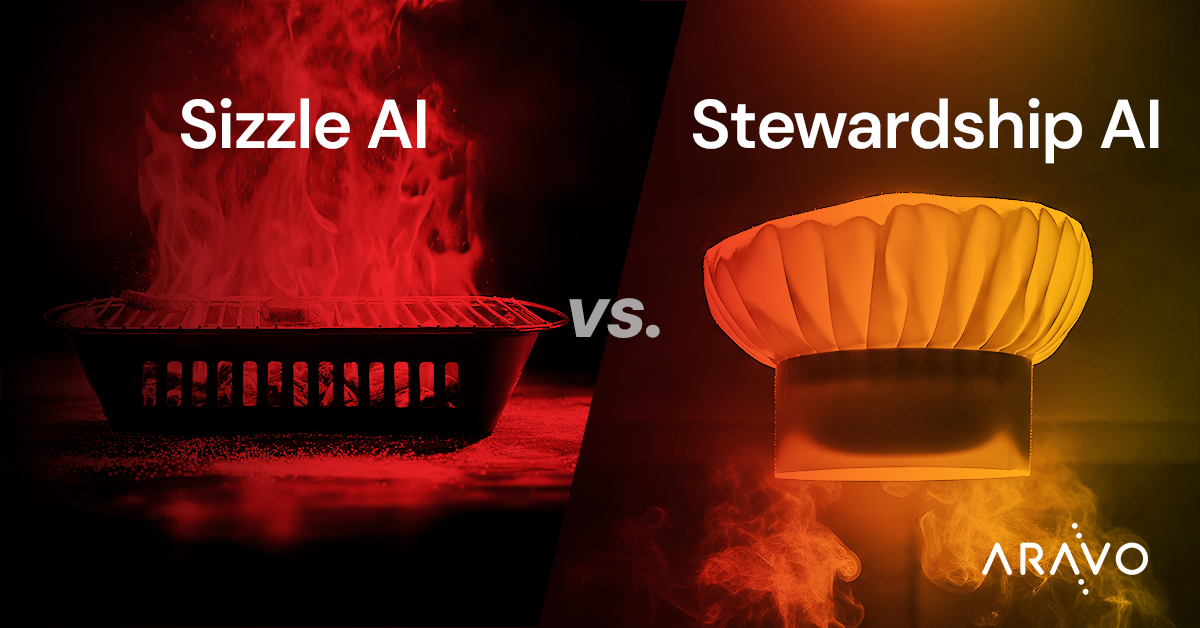
In third‑party risk management, it can feel like a long line of vendors are handing you samples straight off the grill: “AI‑powered this,” “agentic that,” “just add AI and your TPRM bottlenecks disappear.” The sizzle is loud. The question for risk and compliance leaders is simpler—and far more serious: Is this AI actually “cooked through” enough to serve to your regulators, auditors, and board?
That’s the difference between Sizzle AI and Stewardship AI. Sizzle AI looks great on the surface. Stewardship AI is built to stand up to a thermometer check.
Sizzle AI vs. Stewardship AI
Think of Sizzle AI as the conference‑booth version of artificial intelligence. It dazzles in controlled environments, often lives outside systems of record, and is usually described in broad strokes: “just upload a contract and get instant insights,” or “let AI summarize your third‑party risk.”
Stewardship AI is built for a different audience and a different test. It assumes you’ll need to explain and defend AI‑supported decisions to internal audit, regulators, and your board. It understands that accountability doesn’t disappear just because a vendor added an “AI” label to a feature. Stewardship AI is less about novelty and more about whether the organization can stand behind its outcomes.
The six habits of Stewardship AI
Our recent workshop with PwC surfaced a simple pattern: when AI actually works in complex, regulated TPRM environments, it tends to get six things right. Focusing on these six signals helps leaders quickly see whether a solution is built for stewardship or just for show.
It starts with real data, not vibes. Stewardship AI is grounded in governed, complete third‑party data. Not a patchwork of exports, emails, and spreadsheets. It understands your risk taxonomies, scoring models, and historical decisions. Without that foundation, the smartest model in the world will still produce inconsistent, incomplete, or biased results.
It lives where the work actually happens. Instead of asking teams to copy‑paste into a generic copilot, Stewardship AI is embedded in day‑to‑day workflows: vendor onboarding, due diligence, continuous monitoring, issue management, and reporting. Agents appear at the right moments—reviewing survey responses, suggesting remediation, preparing board‑level summaries—so the AI supports decisions in context rather than as a sidecar tool.
It can be explained when the stakes are high. Stewardship AI assumes someone will challenge its outputs. That means risk owners can see why a particular recommendation was made, what information it relied on, and how confident the model was. Decisions are traceable, versioned, and auditable. If your only option is “trust the magic,” you are still in sizzle territory.
It respects governance by design, not by afterthought. In a stewardship model, AI behaves like a model inside a governed risk system, not a productivity toy. Data access is aligned to permissions and policies. You can choose and control which models are used and how guardrails are enforced. There’s clear oversight of how AI is trained, where data is processed, and how behavior is monitored over time.
It scales with the program, not just the pilot. Sizzle AI often shines in one domain or a single region, then stalls when you try to expand. Stewardship AI is domain‑agnostic and global by default. It can support cyber, ESG, ABAC, data privacy, and more, across multiple jurisdictions and operating units. As your program evolves, the AI does not need to be rebuilt from scratch.
It earns trust from the humans who use it. The final habit is the most important: Stewardship AI reduces friction for the people actually doing the work. Managers and analysts experience fewer manual steps and clearer guidance. Directors see better throughput and cleaner evidence. Executives get defensible insight instead of opaque dashboards. When teams rely on AI in real decision making—not just experiments—you know you’ve moved beyond sizzle.
Why this distinction matters now
The demand for AI in TPRM isn’t going away. Third‑party ecosystems are expanding, regulations are converging on accountability, and boards increasingly want to see both innovation and control. Against that backdrop, choosing Sizzle AI isn’t just a technology decision; it’s a governance decision.
Sizzle AI can increase risk in the very function tasked with containing it. Shadow tools, undocumented decisions, and black‑box risk scoring create exposure that only becomes visible when something breaks. Stewardship AI, by contrast, treats AI as an extension of your risk program—not a shortcut around it. It helps you answer the questions that now matter most: who made which decision, based on what evidence, and how do we know we can stand behind it?
From Sizzle to Stewardship in your evaluations
When you evaluate AI‑enabled TPRM solutions, you don’t have to become an AI architect. You do, however, need to ask questions that signal a stewardship mindset:
How does this AI see and understand our data and configurations?
Where, specifically, does it show up in our workflows?
What will an auditor see if they ask us to explain an AI‑supported decision?
How will this scale as we add new risk domains, geographies, and regulations?
What controls do we have over models, guardrails, and ongoing oversight?
Vendors that are serious about stewardship will have clear, specific answers—without hiding behind buzzwords or future‑tense roadmaps.
Ready to give your AI a real temperature check?
Check out our on‑demand workshop with PwC, “Enterprise-Ready AI: A Practical Framework for Evaluating AI Solutions,” before your next AI decision hits the heat.
Daniel serves as a Product Marketing Manager at Aravo Solutions and has a passion for helping organizations see value in technology to understand risk through the context of third parties. Daniel has over 12+ years of professional experience in the Governance, Risk, and Compliance (GRC) space through various SaaS (Software as a Service) providers.
Daniel serves as a Product Marketing Manager at Aravo Solutions and has a passion for helping organizations see value in technology to understand risk through the context of third parties.




 CUSTOMER PORTAL