


 CUSTOMER PORTAL
Aravo vs. ServiceNow TPRM: Purpose-Built Risk Orchestration or Platform Extension?
If your organization already uses ServiceNow, extending it to support third-party risk can seem like the natural next step. But the fact that a platform can route work does not by itself make it the right foundation for a business-critical risk program.
Most organizations would not recreate an ERP inside a workflow platform simply because they could configure approvals there. They choose systems designed to manage core business processes. The same decision deserves attention when third-party risk becomes an enterprise-wide risk and compliance orchestration program.
- ServiceNow offers a dedicated TPRM application within its broader platform, as well as workflow tools organizations can configure and extend. Buyers should be clear about which approach they are evaluating: implementing the packaged application or assembling more of the program from platform workflows and templates.
- Aravo is purpose-built for TPRM. It connects third-party relationships, risk domains, due diligence, workflows, and decision history so organizations can manage an extended ecosystem as business needs change.
The central question is what the program must handle over time: large ecosystems of suppliers, vendors, third and nth parties; internal and external integrations; global deployments; multiple risk domains; and changing business, risk, compliance, and organizational requirements. This comparison looks at how each approach supports that work and what to test.
Aravo and ServiceNow TPRM overview
What is Aravo?
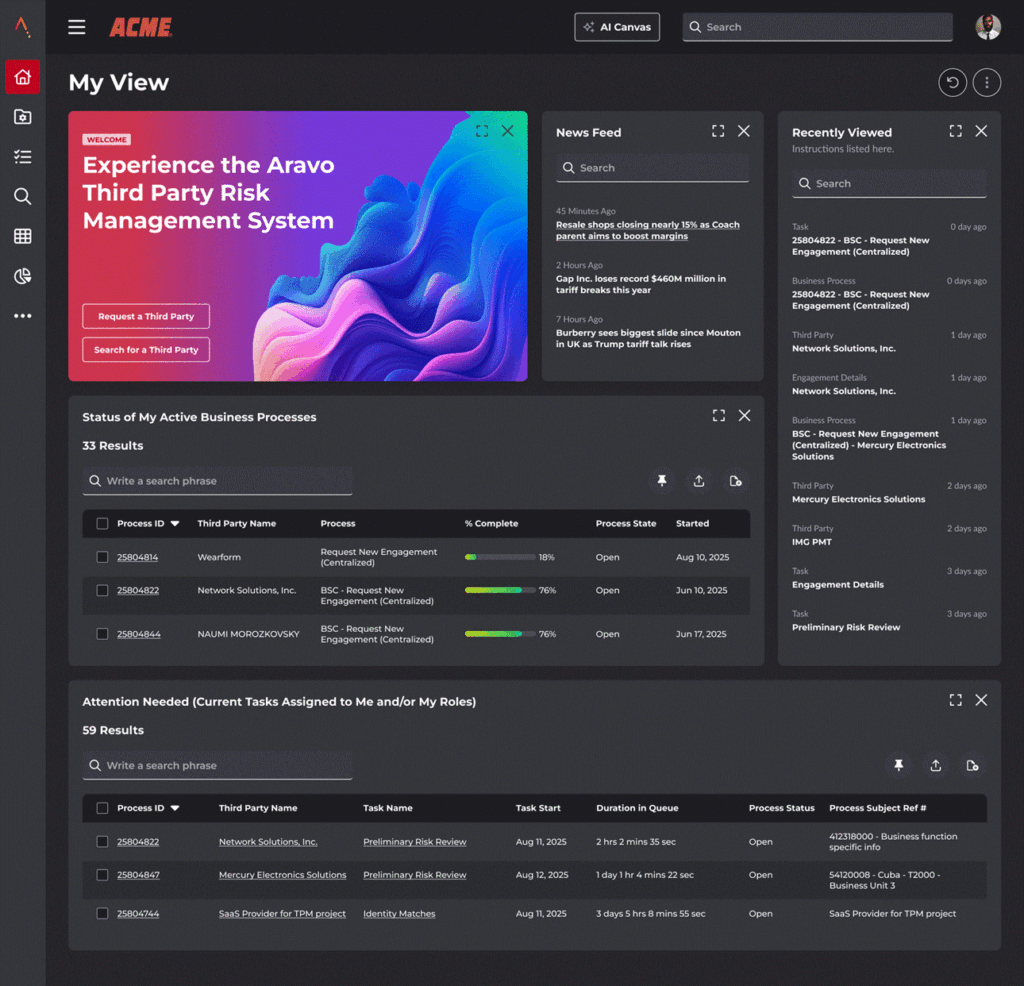
Aravo offers the Intelligence First™ Platform, a purpose-built TPRM orchestration platform for managing risk and compliance across an extended ecosystem of suppliers, vendors, third parties, and nth parties.
Its relationship-centric data model connects third parties to their engagements, services, business units, assessments, controls, issues, and decisions.
Teams can follow how a third party’s role and risk profile change over time, while preserving the evidence and decision history behind earlier reviews.
Aravo supports configurable workflows, risk scoring, and more than 50 risk and compliance domains, including customer-defined requirements.
Organizations can tailor processes for different regions, business units, services, and risk profiles while maintaining coordinated oversight and integrating with internal systems and external risk data.
| “Aravo is a great company with a great product, which has served us well” “We have used Aravo for eight years now, and it has been the backbone of our supplier information and compliance processes. Aravo themselves are excellent to work with and have been highly supportive and understanding of our business goals.” — Aravo customer, manufacturing |
| Pro tip: Evaluate whether the TPRM design can reflect your business processes and change with your risk, compliance, and organizational requirements. |
What is ServiceNow Third-Party Risk Management?
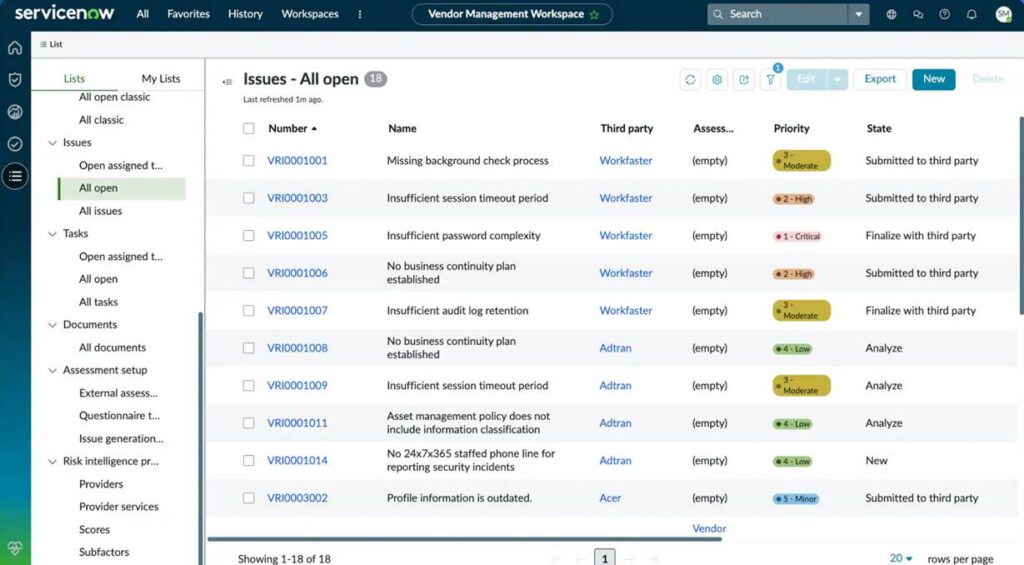
ServiceNow offers a dedicated Third-Party Risk Management application within the broader ServiceNow platform. The application supports third-party records, due diligence, assessments, scoring, remediation, monitoring, and vendor collaboration.
Teams can manage third-party suppliers and engagements, apply configurable assessments, and route approvals or remediation through ServiceNow workflows.
The application can connect TPRM work with other ServiceNow products and processes, including governance, risk, compliance, and security operations.
For organizations already invested in ServiceNow, this can support familiar experiences and platform-level coordination. The important evaluation is whether the packaged application fits the TPRM operating model—or whether the organization expects to build or extend a broader set of workflows to meet its needs.
Aravo vs. ServiceNow TPRM at a glance
Both options provide TPRM capabilities. Their starting points differ: Aravo is a purpose-built TPRM platform, while ServiceNow provides a TPRM application within a broader workflow platform that organizations can also configure and extend.
The comparison below focuses on the architecture, program requirements, and ongoing work involved in each approach.
| Area | Aravo approach | ServiceNow approach |
| Core design orientation | Purpose-built TPRM orchestration for managing third-party relationships and risk over time. | A dedicated TPRM application within the broader ServiceNow platform; organizations can also configure and extend platform workflows. |
| Primary record | Connects activity to the third-party relationship, including its engagements, services, risk, and decision history. | Maintains third-party and engagement records within the ServiceNow environment. |
| Lifecycle coverage | Supports the relationship lifecycle from intake and due diligence through monitoring, remediation, and offboarding. | The packaged TPRM application supports due diligence, assessments, remediation, monitoring, and supplier collaboration. |
| External ecosystem management | Designed for external relationships that can span services, business units, suppliers, and nth parties. | Coordinates internal reviews and supplier participation through its TPRM application and portal. |
| Supplier experience | Provides a supplier portal for information requests, evidence, assessments, and ongoing collaboration. | Provides a Third-Party Portal for assessments, documents, and supplier tasks. |
| Centralized vs. decentralized TPRM | Supports centralized, decentralized, and hybrid program models with coordinated oversight. | Can coordinate work across teams; confirm how the application and any extensions support the organization’s operating model. |
| Risk domain expansion | Supports 50+ risk and compliance domains, including customer-defined assessments. | Supports multiple risk areas through TPRM and related ServiceNow GRC applications. |
| Adaptability | Configure data, risk scoring, workflows, and domains to adapt as requirements change. | Configure the packaged application and related platform workflows; define ongoing ownership for any extensions. |
| Evaluation focus | Consider when TPRM needs a dedicated, configurable operating model across a complex extended ecosystem. | Consider when the packaged TPRM application fits and the organization values integration with its existing ServiceNow environment. |
What are the key differences between Aravo and ServiceNow TPRM?
Platform foundation: Purpose-built TPRM or configured workflows
Aravo
Consider a supplier that has worked with your organization for eight years. It may have added services, changed ownership, or received a risk exception along the way.
Aravo is designed to keep relationship and risk history connected as those changes occur. At renewal, teams can review prior decisions in the context of the supplier’s current engagements instead of rebuilding the picture from separate records.
This continuity becomes especially important when the same third party supports several parts of the business or remains critical over many years.
ServiceNow
ServiceNow also provides a dedicated TPRM application with third-party and engagement records, assessments, and related workflows.
Its broader platform can be an advantage when internal teams already use ServiceNow to coordinate security, IT, and other enterprise work.
The architecture question is whether the packaged TPRM application and its configuration cover the program’s relationship model and risk requirements. If the proposed approach relies on building or substantially extending general workflows and templates, include the additional data design, integration, testing, and long-term administration in the comparison.
| What to test: Show the full history of a long-running supplier, including multiple engagements, a previous exception, a change in ownership, and the current risk view. Ask what is standard, configured, or custom-built. |
Configurability: Managing different requirements across one supplier relationship
Aravo
A single supplier may provide different services to multiple business units. One engagement may require a detailed information security review; another may call for financial, privacy, or resilience assessments.
Aravo supports centralized, decentralized, and hybrid TPRM operating models, with configurable processes tied to the third-party relationship.
Its Evaluate Engine supports risk scoring at entity and engagement levels, helping teams apply review paths that reflect the nature and criticality of each relationship.
The goal is to tailor assessments and approvals without losing the shared view risk leaders need across the supplier relationship.
ServiceNow
ServiceNow’s TPRM application also supports configurable questionnaires, scoring, approvals, and workflows. Organizations can use these capabilities within their ServiceNow environment and connect them to related platform processes.
That can be a strong fit when the packaged application and available configuration align with the program. If additional workflows or data structures are required, identify who will build, validate, document, and maintain them through business changes and platform upgrades.
| What to test: Have two business units assess different services from the same supplier. Check whether each can apply its own risk rules while the organization retains a connected view of the relationship. |
External supplier engagement and collaboration
Aravo
External participation is part of the operating model. A supplier may need to provide new evidence or respond to remediation long after onboarding.
Aravo’s supplier portal supports ongoing information exchange, evidence requests, and assigned tasks across the third-party relationship.
That keeps requests connected as internal and supplier-side contacts change.
ServiceNow
ServiceNow also offers a Third-Party Portal where suppliers can respond to assessments and provide documents.
Its portal and task-routing capabilities can connect external responses with internal assessors and approvers. Buyers should test how access, delegation, and open requests behave when supplier contacts change.
| What to test: Invite an external respondent, request evidence, delegate a task, then change the supplier contact. Check how access, open requests, and history are handled. |
Multi-domain risk management
Aravo
A supplier may meet information security requirements while presenting financial, compliance, operational, or sustainability concerns. A TPRM program needs to understand the risks relevant to each service and relationship.
Aravo supports more than 50 risk domains and lets organizations add customer-defined assessments, scoring, workflows, and reporting as their business and obligations evolve.
| “Meets our complex, global needs for screening third parties” “The Aravo solution delivered meets our complex, global needs for screening third parties for 3 risk areas, collecting and validating supplier information required to support our procure-to-pay transactional processes, and integrating that information with our SAP ERP system.” — Aravo customer, global enterprise |
ServiceNow
ServiceNow’s TPRM application supports assessment and scoring across multiple risk areas and can connect findings with its broader GRC environment.
For either approach, test how a new or changed risk requirement reaches the right third parties and engagements, and how teams avoid duplicating assessments that are still valid.
| What to test: Introduce a new risk requirement for existing suppliers. Ask how each platform identifies affected engagements and applies new reviews without losing prior evidence or repeating valid work. |
IT and security integration
Aravo
Aravo connects with internal systems and external risk intelligence providers so new information can be evaluated in the context of the supplier relationship.
For example, a change in a critical supplier’s security rating can inform risk scoring and trigger a reassessment, escalation, or remediation workflow based on the organization’s rules.
This links external signals to decisions and follow-up actions across the TPRM process.
ServiceNow
ServiceNow has an advantage when security teams already use its platform and want vendor issues to connect with existing Security Operations processes.
The evaluation should include more than internal ticket routing. Test how external intelligence, procurement and ERP data, supplier evidence, and remediation outcomes move across systems—and which integrations or data-management responsibilities remain with your team.
| What to test: Feed a meaningful external risk change into each system. Follow how the signal is matched to the supplier and engagement, who receives the work, and how risk status and remediation are updated. |
AI capabilities and third-party risk context
Aravo
Aravo’s AI agents operate within the TPRM platform, where they can use supplier data, prior assessments, workflows, and program context to help review evidence or recommend next steps.
AI Studio supports the configuration and governance of agents, including alignment with organizational policies and model choices. Human review can remain part of the workflow for decisions that require judgment.
ServiceNow
ServiceNow also offers Now Assist capabilities for TPRM. The specific features available depend on the application release, licensing, and deployment, so buyers should test them against the work they want to automate.
| What to test: Give each system incomplete supplier evidence and ask it to recommend a next step. Review the source material, user permissions, human approvals, and audit trail before any action is taken. |
Governance, auditability, and regulatory complexity
Aravo
For a regulated organization, the record needs to show not only the outcome of a decision, but also the evidence, participants, and actions that led to it.
Aravo maintains a history of assessments, approvals, issues, and remediation activity across the third-party lifecycle.
This helps teams reconstruct why a supplier was approved, how an exception was handled, and what changed when the risk profile shifted.
ServiceNow
ServiceNow also provides audit and governance capabilities through its TPRM and GRC applications. Compare how each system records evidence, decisions, permissions, and follow-up—and how easily teams can retrieve the full record for an examination.
| What to test: Request the complete history behind an old approval, including evidence, decision makers, exceptions, and later changes. Compare how easily the record can be retrieved and explained. |
Platform consolidation and existing ServiceNow investment
ServiceNow
An existing ServiceNow investment can be a practical reason to evaluate its TPRM application. Familiar interfaces, platform administrators, and existing integrations may support adoption and coordination.
Those advantages matter when the packaged TPRM capabilities align with the organization’s requirements and the platform can support the needed external connections.
Platform consolidation alone does not establish lower cost or effort. Compare what is included with the application, what must be configured or custom-built, and the administration and integration work required over time.
Aravo
Aravo offers a dedicated TPRM foundation that can integrate with ServiceNow and other enterprise systems. This can let each platform support the work it is designed to manage while maintaining connected processes and data.
| What to test: Map the supplier tools and systems in use today. Compare which processes each approach can replace, which systems still need to connect, and who owns the integrations and data. |
Implementation and ongoing ownership
Aravo
Aravo provides TPRM-specific capabilities and implementation services to configure the platform around the organization’s third-party risk requirements.
Implementation still requires planning for relationship data, integrations, operating roles, risk domains, and governance. A purpose-built starting point can reduce the need to assemble those core TPRM capabilities from general workflow components.
ServiceNow
ServiceNow also requires implementation planning. Teams need to configure the TPRM application, connect it with relevant systems, and assign ownership for administration and ongoing program changes.
| Pro tip: Confirm who can change assessments, business rules, integrations, and workflows after launch—and how those changes are tested, documented, and maintained. |
For a ServiceNow-based design, ask the implementation team to distinguish the packaged TPRM application from platform configuration and custom development.
Request an itemized view of the work for data structures, relationship hierarchies, risk domains, external integrations, approvals, reporting, and supplier access.
Then ask how that configuration will be maintained through regulatory changes, organizational changes, and platform upgrades. Apply the same questions to Aravo’s configuration, integrations, and services.
| What to test: Identify who can change an assessment, workflow, or integration after launch. Ask how updates are tested, documented, approved, and maintained through platform upgrades. |
Aravo vs. ServiceNow TPRM pricing
Neither Aravo nor ServiceNow publishes standard pricing for every enterprise TPRM deployment. Costs depend on scope, licensing, configuration, integrations, and services.
ServiceNow
For an existing ServiceNow customer, the current platform footprint may improve the economics—but only if the TPRM application and implementation meet the program’s needs.
Confirm which licenses and products are required, which implementation resources are included, and how much ongoing platform administration the design will need.
Aravo
Aravo requires a dedicated TPRM platform investment. Compare that cost with the effort to configure, build, integrate, validate, and maintain the alternative over the life of the program.
| Pro tip: Compare total cost of ownership, including implementation, licensing, internal administration, consulting, integrations, upgrades, and the cost of adapting the program as requirements change. |
| Recommended whitepaper → How Centralized TPRM Saves Time and Costs |
Analyst recognition and user reviews
Aravo
Aravo was named a Leader in the 2026 Gartner Magic Quadrant for Third-Party Risk Management Tools for Assurance Leaders. It also earned Chartis Research’s Category Leader recognition for the sixth consecutive year.
| “A highly customizable and versatile system” Aravo is an excellent tool for managing end-to-end processes, with tailored workflows, emails, and chase cycles built into the automated system capability. Aravo’s strength for me lies in its traceability and high level of automation. Aravo is a highly customizable and versatile system.” — Aravo customer, global manufacturing |
ServiceNow was included in Gartner’s 2025 Magic Quadrant for Governance, Risk and Compliance Tools for Assurance Leaders. That’s a broader GRC and assurance category, not a TPRM-specific evaluation, so it does not by itself establish leadership in third-party risk management.
ServiceNow also received TPRM-specific recognition: Forrester named it a Leader in its 2024 Wave for Third-Party Risk Management Platforms. Compare each report’s date, market scope, and criteria, then validate the current product against your requirements.
When reviewing customer feedback, look for evidence that reflects your use case, implementation scope, and operating model.
References should address both the product and the work required to configure, integrate, and sustain it.
Aravo vs. ServiceNow: Choosing the right TPRM foundation
The decision depends on whether the organization needs a dedicated TPRM operating model or whether the packaged ServiceNow TPRM application can support its requirements within the broader platform.
- ServiceNow may fit when its packaged TPRM application meets the program’s needs, the organization already relies on the Now Platform, and platform-level integration and administration are central priorities.
- Aravo may fit when third-party risk is a core enterprise risk and compliance responsibility across a large, changing ecosystem—and the program needs configurable relationship management, multiple risk domains, global workflows, and integration with many internal and external systems.
Most organizations would not recreate an ERP inside a general workflow platform simply because it can route work. Apply the same discipline to enterprise risk and compliance orchestration: evaluate the purpose-built system against the platform-based approach, including what each requires to implement, adapt, and sustain.
| “ROI is not just positive, it’s massively positive” Aravo provides [our organization] with a globally accessible application for the management of critical information around our supply base and allows us to syndicate the information to our various purchasing, payables and other systems so that we can have one coordinated view of all supplier activity and commitments. We are confident that the ROI is not just positive, but it’s massively positive.” — Aravo customer, enterprise procurement |
| See how Aravo helps enterprises manage third-party risk as requirements evolve. Request a demo with the Aravo team → |
FAQs
Which platform is better for managing third-party risk across a complex ecosystem?
Aravo is purpose-built for TPRM programs that need to connect third-party relationships, multiple risk domains, workflows, and decision history across the lifecycle.
ServiceNow’s TPRM application can be a strong fit when its capabilities and the broader Now Platform align with the organization’s processes and integration strategy. Evaluate both against your actual scale and requirements.
Can ServiceNow scale to manage hundreds of thousands of vendors?
ServiceNow offers a dedicated TPRM application, but public product descriptions don’t establish how a specific configuration will perform with hundreds of thousands of vendor records. That does not mean it can’t scale to that volume. Ask for a comparable customer reference and validate performance using your expected vendor and engagement counts, assessment volumes, supplier-portal concurrency, integrations, monitoring, and reporting workloads.
Can Aravo and ServiceNow be used together?
Yes. Aravo can provide the dedicated TPRM system while ServiceNow supports IT service management, security operations, or other enterprise workflows.
The integration design should define which platform owns each record and process, what information moves between them, and how teams avoid duplicate work.
What should teams test in an Aravo vs. ServiceNow proof of concept?
Use scenarios that reflect your operating model: one supplier with multiple services and business owners; a new risk domain or regulation; a material change from an external data source; and a remediation that requires action across teams.
Ask each vendor to show how the data, workflow, integrations, approvals, and audit history work—and identify which capabilities are standard, configured, or custom-built.
When should enterprises consider a purpose-built TPRM platform instead of extending ServiceNow?
Consider it when the program must coordinate multiple risk domains, complex third-party relationships, global requirements, and several internal and external systems.
If the required design depends on extensive custom development or ongoing platform work, compare that total effort with a dedicated TPRM solution such as Aravo.

Aravo Content Team
Share with Your Friends:


